How to Use Storytelling to Make Your English Sessions More Engaging

At ENGin, our volunteers hold thousands of online English conversations with Ukrainian students every week. One question we hear often is: how do I make our sessions feel less like a lesson and more like a real conversation? The answer, more often than not, is storytelling. In collaboration with betterclass, we're sharing this practical guide to help ENGin volunteers — and anyone teaching English online — bring more energy and connection to their sessions.

Storytelling is the thing that makes English click. Once a student gets caught up in what actually happened, they stop fussing over verb tenses and start reaching for words because they want to be understood. That shift, from worrying about the language to wanting to use it, is the whole point of the lesson.
In collaboration with betterclass and their recent lesson for B1 learners, "Everyone Has a Story," we're sharing some practical tips for making your English sessions more engaging through storytelling. The best part is that everyone already has stories. Your students know exactly what happened on their worst Monday or their funniest day at work. The only things missing are the language and the confidence to tell it in English. That is precisely what a good storytelling lesson builds.
Below, we'll walk through a complete lesson flow, from a relaxed warm-up to students confidently telling their own stories, plus a handful of extra activities you can pull out anytime your sessions start to feel a little flat.
1. Start with a low-pressure warm-up

Before you say the word "story," just get them talking. Put up the slide with its three ordinary pictures and ask, "What do you think happened here?" That's the entire instruction. There's no right answer, no grammar to nail, and nothing to get wrong, which is exactly why it works. Guessing feels like a game, and games are easy to say yes to.
The good stuff comes from how differently people read the same photo. One student looks at a broken-down car and sees a ruined morning. Another sees two friends about to have an adventure. That gap is what you want, because it starts an argument nobody planned, and unplanned talk is the best kind. Once a couple of those small disagreements are running, you bring it home with one question: "Has anything like this ever happened to you?" Now it's personal, and personal is what loosens people up.
From there you can push a little further with the follow-up questions:
Who's the best storyteller you know, and what makes them good?
Do you ever tell the same story more than once?
Do you think everyone has interesting stories to tell?
These get students thinking about stories as a normal part of life rather than a classroom task, which is half the battle. By the time you move on, plenty has happened under the surface. You've pulled up what students already know, dropped the anxiety, and got every mouth in the room moving before anything hard shows up.
This kind of warm-up works especially well in volunteer-led online English sessions — like those run through ENGin — where the goal is conversation, not instruction. The more relaxed the opening, the more natural everything that follows.
2. Introduce the storytelling formula

The storytelling formula splits any story into five beats: the beginning, the event or problem, the action, the climax, and the ending. Each beat comes with a phrase or two to grab onto. "It all started when..." to open. "Suddenly..." when things go sideways. "Looking back..." to bring it home. Read together, the phrases more or less tell a story on their own, which is the point.
Keep it simple on the first go. You can trim the formula or swap phrases later, but this version covers the vast majority of stories anyone will ever tell, so there's no reason to pile on options before they've used it once. Give them a few minutes with the slide, then ask a question or two to check they're following.
And say this part out loud, because it matters more than the formula itself: not every story has five tidy steps, and that's fine. The formula is a map, not a script.
If you want a full set of ready-made b1 lesson plans with this structure already built in, betterclass has them, on any topic you can think of, all built around this same idea of handing students a clear shape to follow.
But the shape is only ever a starting point. What you're after is fluency and nerve, not a student marching through five steps like a robot reading a list. So tell them they can skip a beat, stretch another, do whatever the story needs. Once they see the formula as a handrail, they relax and the stories get better.
3. Build confidence with audio practice

Knowing the formula and trusting it are two different things, so before anyone tells their own story, let them hear a good one. Play the first clip, "Wrong Bus," is barely over a minute: a traveller in Portugal realizes far too late that she's on the wrong bus with a flight to catch, until a stranger at a bus stop steps in. It's small, real, and a little bit funny, which is exactly the register you want students aiming for. They listen and answer three quick questions:
What happened?
Was it a good story, a bad one, or a bit of both?
Have you ever been through something like it?
There's a second clip in the lesson too, "Dinner for Friends," if you want to run the stage twice.
Then comes the part that really earns its place. Students fill in a table that breaks the story into setting, problem, action, turning point, and ending. Suddenly the formula from the last stage stops being theory. It's right there, working, in a story a real person actually told.

Do that, and you can watch it land. Students have heard the phrases doing their job, they've spotted the structure for themselves, and now they have something to copy.
4. Let students tell their own stories

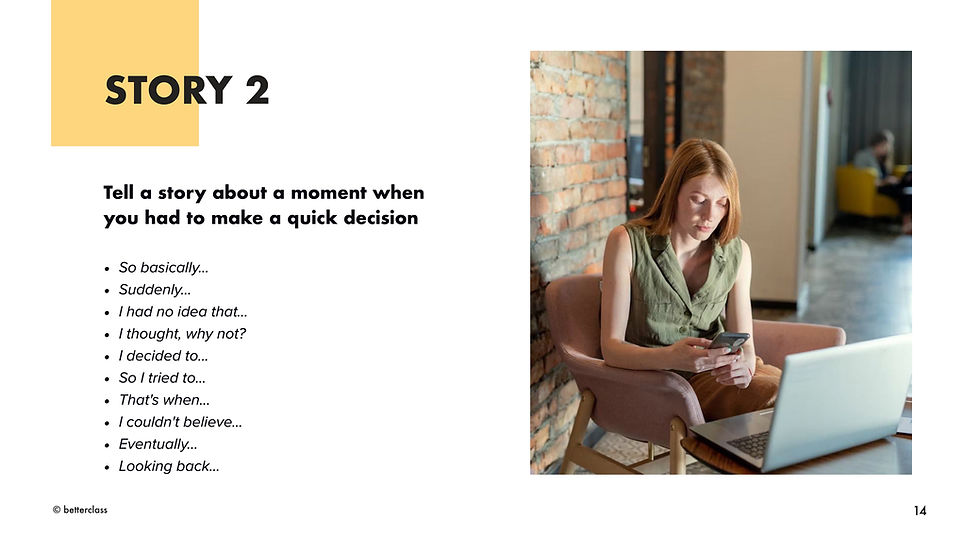

This is the part the whole lesson has been building toward. There are three prompts to pick from:
A time you were late for something that mattered
A moment you had to decide fast
Something funny that happened at work or school
Each one comes with its own set of phrases, so there's always a handrail if someone freezes halfway through.
They work because everyone has lived all three, which means nobody has to invent anything, and that takes the pressure right off. How you run it depends on the room. You can do pairs first and then the whole group, or a quick lap where everyone shares one.
All three prompts are pulled from the "Everyone Has a Story" lesson, which you'll find among betterclass's esl lesson plans for adults if you want the whole sequence ready to teach.
One thing worth holding the line on while they talk: don't pounce on every mistake. Let them finish. Note down a few slips and come back to them later, because the moment you interrupt the flow, the story dies, and the confidence goes with it. Save the feedback for the end, make a real point of the effort, and people come back next week wanting to talk.
For ENGin volunteers leading free online English sessions with Ukrainian students, this stage is especially powerful. Many students have lived through extraordinary experiences over the past few years. Giving them the language and the structure to talk about their own lives — in English, with someone who genuinely wants to listen — is one of the most meaningful things a volunteer conversation session can do.
5. Keep it fresh with extra activities
Once students settle in, you don't have to run the full lesson every time. A few small twists keep storytelling alive across the weeks, and they're easy to drop in. Better still, they reward people for listening to each other instead of just waiting for their own turn.
Pause and Predict. Stop partway through a story and have listeners guess what comes next. Now everyone's leaning in instead of zoning out.
Follow-up Questions. When a student finishes, the others dig for details, and the conversation keeps going on its own.
Picture Prompts. Students build a story from a single image or a sequence of them. Good for the ones who swear they have nothing to say.
Collaborative Storytelling. The whole class builds one story together, each person adding a sentence, a twist, or a new character.
Story Cubes or Random Words. Hand out a few random words they have to fit into the story somehow. The dumber the combination, the more fun it is.
Truth or Fiction. A student tells a short story and the class votes on whether it really happened. The teller reveals the truth at the end.
Pick whichever fits the mood that day. They all work the same skills, so nothing is wasted, and the routine never gets the chance to go stale. If you're ever stuck for ideas between sessions, we've also put together guides on what to do when your session goes silent and how to use YouTube videos for conversation practice — both worth bookmarking.
Wrapping up
Storytelling works because it walks a natural line from low pressure to real confidence. You start easy so nobody feels cornered. You hand over a simple formula so nobody's staring at a blank wall. You let students hear good stories before making their own. And then you give them prompts that connect to their actual lives. By the time they're telling their own, they've forgotten they're doing an English exercise. They're just talking, which was the idea from the start.
There's a Native American proverb on the last slide of the lesson that explains why this works: "Tell me the facts and I'll learn. Tell me the truth and I'll believe. But tell me a story and it will live in my heart forever."
The same goes for the language tucked inside it. New words and phrases stay put because they're attached to something the student actually cares about. So give storytelling real room in your sessions. Everyone really does have a story. Your job is just to get it out of them.


